Fused Silica and Silicon Nitride-bonded Silicon Carbide (Si3N4-SiC) for molten aluminum launder
In the selection of materials for the Molten Aluminum Launder lining, fused silica and (Si3N4-SiC) bonded silicon carbide are currently the two most commonly used types of refractory materials in the international casting industry. There are significant differences between them in terms of thermal properties, erosion resistance, and economic benefits.
Comparative Performance Matrix:
| Performance Metric / Feature |
Fused Silica |
Silicon Nitride-Bonded Silicon Carbide (Si3N4-bonded SiC) |
| Thermal Expansion Coefficient |
Extremely Low ($\sim 0.5 \times 10^{-6} /\text{K}$) |
Moderate ($\sim 4.5 \times 10^{-6} /\text{K}$) |
| Thermal Shock Resistance |
Exceptional (Minimal preheating required; resists cracking) |
Good (Requires proper preheating schedule) |
| Thermal Conductivity |
Low (Superior natural insulation; minimal temperature drop) |
High (Rapid heat transfer; requires thick backup insulation) |
| Non-Wetting / Corrosion Resistance |
Good for pure aluminum; reactive with high-Mg alloys |
Outstanding ($\text{Si}_3\text{N}_4$ matrix is completely non-wetting to molten Al) |
| Mechanical Strength & Wear Resistance |
Low to Moderate (Prone to damage during manual drossing) |
Extremely High (Superior erosion, impact, and wear resistance) |
| Corundum Growth Resistance |
Moderate (Susceptible to reduction reactions over time) |
Exceptional (Prevents corundum adherence and buildup) |
| Initial Capex / Material Cost |
Low / Cost-Effective (Easy to cast into complex shapes) |
High (Complex nitriding/sintering process) |
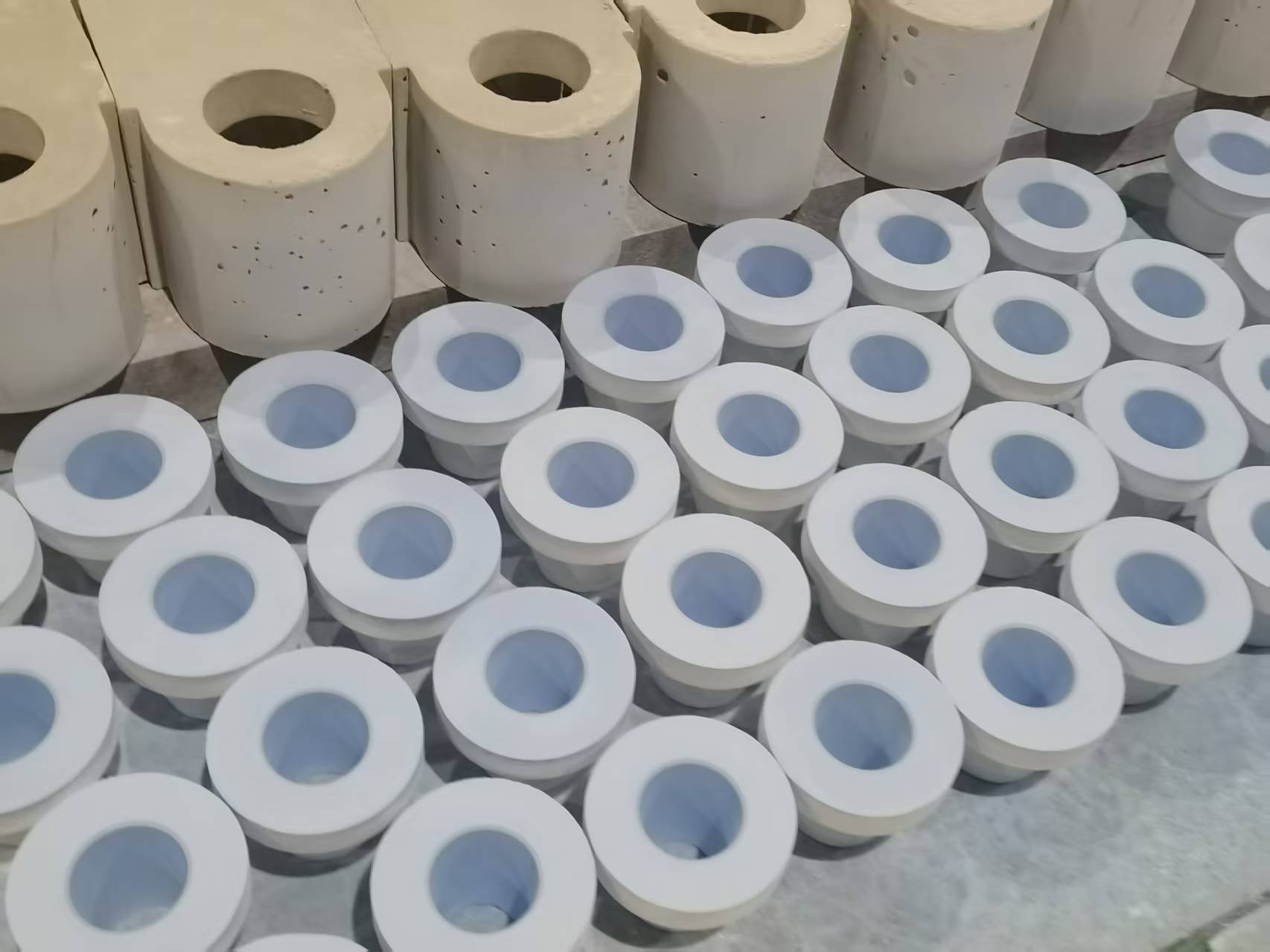
In-Depth Breakdown
1. Fused Silica
Key Advantages:
Exceptional Thermal Shock Resistance: Its virtually zero coefficient of thermal expansion allows cold start-ups without extensive preheating procedures and prevents stress cracking.
Built-in Insulation: Low thermal conductivity minimizes temperature drop across the metal transfer path without needing excessively thick backing layers.
Cost-Efficiency: Economical raw materials and straightforward casting techniques make it highly cost-effective for custom and complex shapes.
Key Limitations:
Mechanical Vulnerability: Relatively soft surface renders it susceptible to mechanical damage during manual tool drossing and high-velocity melt erosion.
Chemical Reactivity with Magnesium: When transporting high-magnesium alloys , the SiO2 matrix reacts with $\text{Mg}$, causing lining degradation and contamination.
Shorter Service Life: Long-term exposure to high temperatures can trigger devitrification (cristobalite formation) or corundum growth, reducing service lifespan.
2. Silicon Nitride-Bonded Silicon Carbide Si3N4-SiC
Key Advantages:
Unmatched Non-Wetting Properties: The $\text{Si}_3\text{N}_4$ bonding phase prevents molten aluminum from adhering, eliminating corundum accumulation and making cleaning effortless.
High Structural Strength & Longevity: Exceptional hardness withstands physical impact from cleaning tools and heavy fluid turbulence, offering a service life 3 to 5 times longer than fused silica.
Broad Alloy Compatibility: Chemically inert against aggressive molten aluminum alloys, including high-Mg and high-Si grades.
Key Limitations:
High Thermal Conductivity: Transfers heat rapidly; must be paired with high-performance microporous insulation board or aerogel backings to avoid heat loss.
Preheating Protocol Required: Higher thermal expansion requires controlled preheating cycles to prevent localized thermal stress cracks.
Higher Capital Expenditure: Complex nitrided manufacturing processes result in significantly higher initial purchasing costs.
Application Guidelines:
Select Fused Silica when:
Operating intermittent or batch casting lines with frequent shutdowns and thermal cycles where quick start-ups are essential.
Managing tight initial budget constraints (Capex-sensitive projects).
Fabricating complex, non-standard refractory shapes (e.g., flow control boxes, distribution dams, transition pieces).
Processing primarily standard commercial purity aluminum or low-alloy grades.
Select Si3N4-SiC when:
Running continuous, high-capacity casthouse lines aiming for maximum uptime and minimal maintenance downtime.
Transferring high-magnesium or aerospace-grade aluminum alloys that demand ultra-high melt purity.
Lining high-impact zones, such as furnace taphole exit points, inline degasser inlets, or areas requiring frequent mechanical drossing.


